Jonas Lindgren
Principal
Managing external patent firms as an extension of your IP strategy
Most companies do not have a strategy for their external IP network; they have a firm list. The network has accumulated over decades through acquisitions, jurisdictions, and habit. Every firm is engaged the same way, and the result quietly caps the quality of the entire IP strategy.
External firms are the execution arm of your IP strategy. They draft and prosecute the patents that determine whether business choke points are actually controlled or only nominally covered. Which firm drafts your most critical family is a strategic question, and in most networks it is answered by accident.
Leading IP functions manage the network the way they manage the portfolio itself. Firms are segmented into three tiers, Strategic Partners, Volume Partners, and Specialists, each with its own selection logic, price logic, and depth of relationship. Governance, reviews, and planning all scale with the tier.
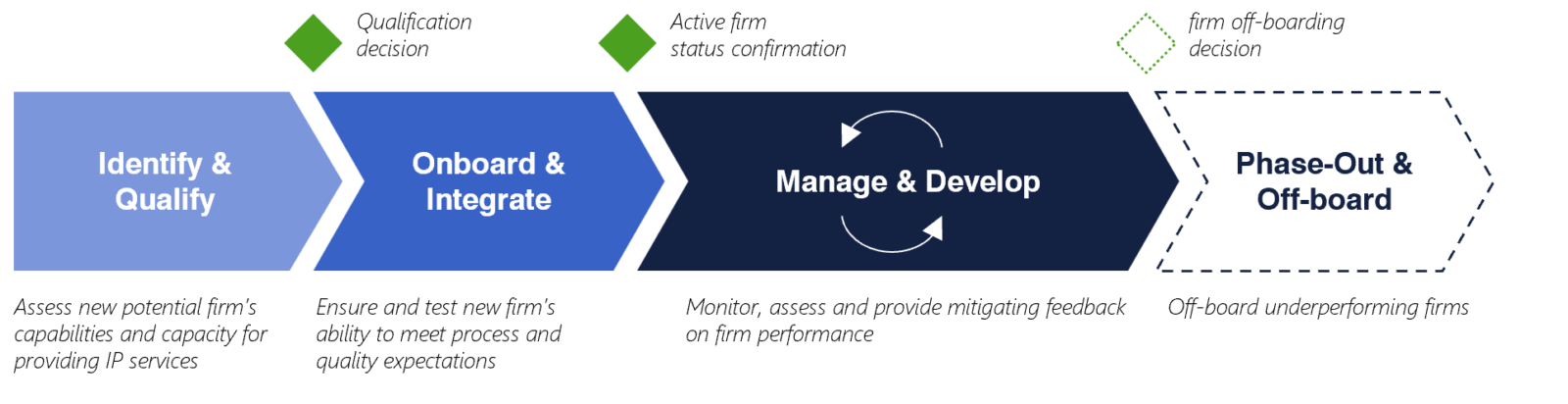
Relationships are managed as partnerships across a full lifecycle. Key firms are measured on five dimensions including strategic contribution, developed through structured two-way business reviews, and, when performance or fit no longer justifies the relationship, off-boarded through a planned transition rather than tolerated indefinitely.
Joint planning and AI are raising the ceiling. Companies that share demand forecasts with their firms, and that structure how AI-driven efficiency gains are measured and shared, will get better work at better terms. Companies that leave this unaddressed will pay yesterday's prices for tomorrow's productivity.
A strategy for your external IP network is the deliberate design of which external patent firms, or outside counsel, build which parts of your patent portfolio, under what kind of relationship, and why. Most IP departments do not have one. They have a list of firms, a set of rates, and a habit of sending work to whoever handled the last case. The result is a network that treats a foundational invention and a routine continuation the same way, and quietly caps the quality of the entire IP strategy.
In our recent white paper, The CIPO advantage: what great looks like in 2026, we argued that leading IP organisations treat intellectual property not as a legal right but as a means to control business choke points: the few places where speed, margin, and bargaining power concentrate. They deliberately mix IP value models. They coordinate patents, trade secrets, data rights, and contracts to secure the points that matter.
Now follow that logic one step further. If a handful of patent families carry a disproportionate share of business value, then the question of who drafts them is a strategic question. A choke-point patent drafted by whichever firm happened to have capacity that week is a strategic decision made by accident.
Yet that is how most networks operate. Firms accumulate over decades: inherited from acquisitions, added for a jurisdiction, kept out of loyalty. Every firm is engaged the same way, with the same instructions, the same review process, and the same annual rate discussion. Nobody can say which relationships are strategic and which are transactional, because the network has never been designed. It has only grown.
This matters more than it looks. External firms typically execute the majority of a company's patent work: drafting, prosecution, filings across dozens of jurisdictions. The strategy may be set in-house, but it is realized, or not, in the claims an external attorney writes. A brilliant portfolio strategy executed by an undifferentiated network is a brilliant strategy on paper only.
The most effective IP functions have drawn the obvious conclusion: they handle their external network in the same way that they manage the portfolio itself; segmented by strategic value, governed differently by segment, and actively developed and pruned over time. In practice, this rests on four principles.
The starting point is a make-buy logic that mirrors the portfolio strategy, case by case.
Benchmark companies increasingly apply a tiered approach. Cases of high strategic importance are handled with internal resources as far as possible, not only for quality control but to build and retain the internal expertise that strategic work depends on. Cases of lower importance are outsourced end-to-end through a streamlined, standardized process, with minimal internal involvement and minimal variation from one attorney to the next.
Observe the change. The conventional approach is based on activity: "we outsource drafting, we keep prosecution." The modern approach is based on case importance: the same activity is handled entirely differently depending on what the case is worth to the business. That is the portfolio strategy, mirrored in the sourcing decision.
This has an uncomfortable implication for many departments: it requires knowing, case by case, which parts of the portfolio are strategically critical. Departments that cannot make that call cannot differentiate their sourcing. That is often the first sign that the portfolio strategy itself needs sharpening.
A European industrial company had a profitable product portfolio and a problem that did not show up on any P&L. Digitization and automation were pulling new competitors into its market, and these entrants had something the usual rivals lacked: long experience of using IP as a weapon. When the company's newly hired Digitization Officer mapped the threat, the trail led straight to the IP department.
The Head of IP, the CTO, and the Digitization Officer reached the same conclusion: the IP function had to shift from processing cases to preparing for a fight, and it could not do both with the resources it had. The answer was not headcount; it was a redesign of the external network.
A global re-sourcing of IP services, built on clearly defined roles and service items, brought in firms with expertise in precisely the technologies where the battle would be fought, and freed the internal team from operational load. Time available for strategic work tripled. When the disputes come, the department will not be meeting them mid-firefight.
Once the decision has been made regarding whether to make or buy, the external network can then be designed in accordance with that decision. This involves organization design just as much as it does procurement. As we argued in Organizing for business-driven IP management, a modern IP operating model is more than lines and boxes on an internal org chart; the external network sits in the same layer as the internal structure, the organization and its interfaces, and it deserves the same design attention. In practice, leading IP functions segment their firms into tiers, each with its own selection logic, price logic, and depth of relationship. The exact segmentation model can vary, but typically includes some variation of the following:

Tier 1: Strategic Partners. A small number of firms entrusted with high-complexity, foundational inventions, where the goal is legal bulletproofing and cost is secondary. Typically top-tier boutiques with deep technical alignment to the company's core R&D. These firms should know the product roadmap, understand which families anchor which business plays, and be treated as co-creators of the portfolio, not as contractors executing instructions.
Tier 2: Volume Partners. Firms handling the high-volume core of the portfolio, where the goal is standardization, speed, and cost efficiency at consistently good quality. Often firms with a unified technology stack and global reach, able to run cross-border filing and prosecution with low-touch efficiency. Volume concentrated on few firms buys leverage, priority, and predictable pricing. It also buys flexibility: a committed Volume Partner is the shock absorber that lets a lean internal organization handle workload peaks without panic hiring.
Tier 3: Specialists. Small technical boutiques engaged for frontier technologies such as quantum or bio-convergence, where generalist firms lack depth. Used selectively, at a justified premium, for the cases that demand them.
The in-house attorneys at one technology company knew exactly what they should be doing: licensing, litigation, proactive support to innovation. They spent their days doing almost none of it. Budgets were under continuous scrutiny, recruitment was off the table, and operational work absorbed everything.
Instead of asking for people, the department mapped every activity it performed and asked who should really be doing each one. The result was a rebalanced service model and a deliberate consolidation: case volume concentrated on a small number of carefully selected firms.
The firms noticed. Being a large client of a few firms, rather than a small client of many, bought a kind of commitment no contract clause delivers: closer collaboration, higher quality, and firms who stepped in without drama when workload unexpectedly spiked. Administrative work fell to a tenth of internal time, fees fell as a by-product, and the attorneys got their real jobs back.
Most companies review their firms the way they review invoices: backward-looking, cost-focused, and only when something goes wrong. Leading IP functions run structured relationship management instead, and three practices stand out.
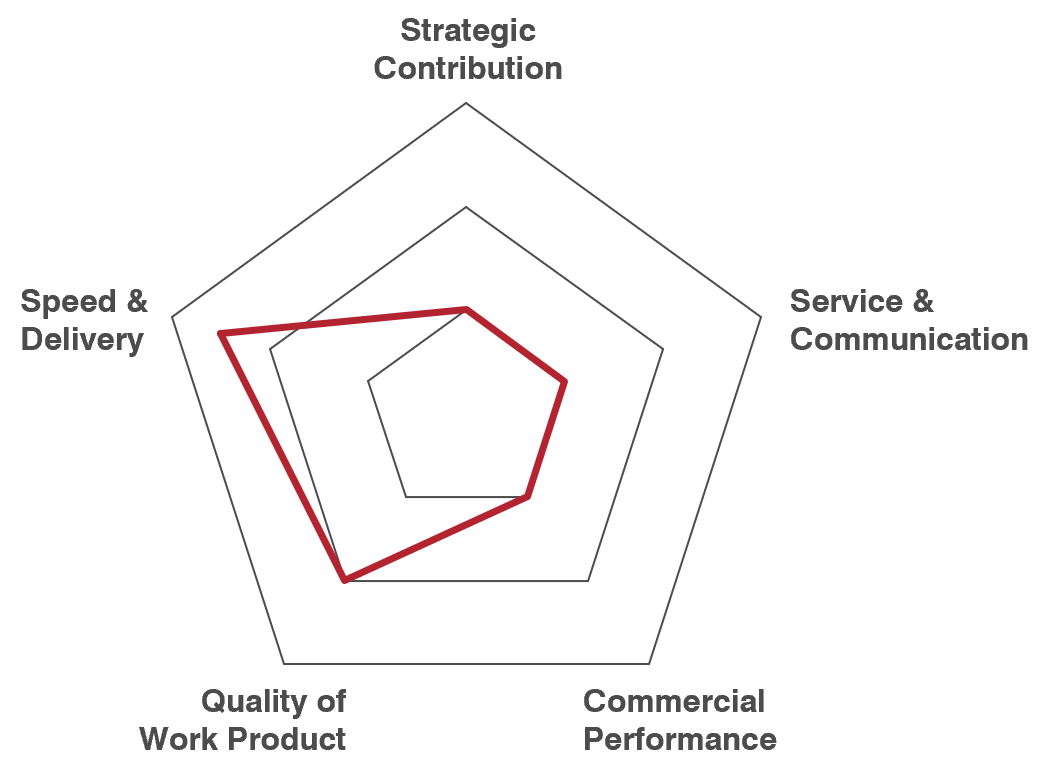
Ask an IP department which of its firms drafts best and the answer will rest on reputation, relationships, and the last case anyone happens to remember. Two companies decided to stop guessing.
The first, a multinational with a large filing volume, runs a standing blind-review process. Work samples are drawn at random, anonymized, and scored by a panel of senior experts against a defined quality standard, with results tracked down to the individual attorney. The design is deliberately uncomfortable: no firm's standing in the network rests on anything except what its work product shows.
The second, a global healthcare company, complements human judgment with machine scale. AI-supported analysis of billing and case-management data surfaces quality signals no panel could review case by case: time to file, extension frequency, patterns in prosecution cycles.
Together, the two approaches replace the question "do we like this firm?" with a better one: "what does this firm's work actually show?"
Patent portfolios are pruned. Underperforming assets are abandoned, and budgets are redirected to what matters. Almost no IP department applies the same discipline to its firms. Relationships begin with scrutiny and then simply persist; the network's exit door is unmarked and rarely used. Leading functions treat every firm relationship as a lifecycle with four stages, each managed with intent and purpose.
None of this should be taken as a justification for churn. The strategic partnerships in question should be long-term and stability should be seen as one of their benefits. On the contrary, it is about intent: each firm in the network is there as a result of a decision that is continually reviewed, and all parties on both sides are aware of this.
Two developments are raising the ceiling on what a well-designed network can deliver.
The first is joint planning. Companies with a clear view of their R&D pipeline are turning it into rolling demand forecasts by technology area and jurisdiction, and sharing that forward visibility with their Strategic and Volume Partners. A company that can see next year's workload can staff for it, commit to it, and price it. Forecasting turns the client from an unpredictable source of urgent work into a client worth investing in.
The second is AI, on both sides of the relationship. As we explored recently in The IP Catalyst and AI-powered portfolio engineering, leading IP functions are weaving AI into their own operations in a disciplined, use-case-driven way. The frontier is doing the same across the network: actively enabling firms to use AI tools safely on the client's work, and agreeing up front how the resulting efficiency gains are measured and shared. Companies that leave this unaddressed will pay yesterday's prices for tomorrow's productivity. Companies that structure it will not.
Both practices depend on the foundations above. You cannot plan jointly with a network you have not segmented, and you cannot share AI gains with firms you only meet at invoice time.
The state of an external IP network is easy to test, yet any Head of IP who can answer all six of the following questions comfortably is in rare company:
If several of these are hard to answer, the network is running on inertia. That is normal; it is how nearly every network was built. But the companies described in this article show that it is a choice, not a given. The portfolio has a strategy. The network that builds it deserves one too.